Particular Service · No. II
Farthing Jane
A story from the world of the Orion Universe
Jackson Tran
Sent to readers of the Greybriar Codex
Greybriar · Section Three
Records and Assessment
Farthing
Jane
The action off Toulon, April 1814, and what it cost the officer who fought it. Compiled from the testimony of two witnesses, the printed record, and private correspondence.
File S3/Hist-11 · Particular Service, No. II
Restricted · Compiled for instruction
With the Approval of the strachan foundation™,
the assistance of Eastbourne House, London,
and the full blessing of ms. anne strachan-warwick
Front matter
The File
This file is issued for instruction. The famous Farthing Jane serves as an example to any Charism who seeks to make a difference in this world. As an archivist, my goal is to present this material as faithfully as possible.
Strachan gave no account of Toulon. She refused a subscription, a soap, and a memoir in one morning of August 1814, and refused every application afterward on the same terms. She left letters and nothing else. What is known of the afternoon comes from two men who served with her and were willing to be asked.
Davey Pryce was once workhouse boy. At fifteen he was a ship's boy. He died a post-captain. This Section has no second example of that achievement, and it should be borne in mind when reading what he says about the woman who chose him. He held her timekeeping thread through the whole of the action at Toulon, as well as subsequent actions in New Orleans and beyond. His account therefore contains her own reasoning, which no other witness could supply and which this Section, after four sittings, regards as reliable. Where he reports her mind he says so.
Ross was interviewed at Gosport in 1849, aged seventy-five; he sat once and declined a second sitting. Pryce was deposed at Greenwich in 1878, aged eighty-one and forty years an officer. He gave his account over four sittings. Their testimony was taken thirty years apart. Neither man was shown the other’s testimony.
The transcripts, the Gazette sheet, and the print are held at Eastbourne House, London, and are reproduced here by their courtesy. The private letters were presented by and reproduced with the full blessing of Strachan’s descendant, Eastbourne Charism Anne Strachan-Warwick. The reader should understand that without Eastbourne House, the Strachan Foundation™ (which requires this Section to reproduce the mark as shown), and Ms. Strachan-Warwick, there would be no file.
A note on terms. Weight, Magazine, and Gunnery were the words of the period; current usage is Throughput, Capacity, and Efficiency. They are not corrected here. An officer who cannot read the older terminology has no business in the archive.
The documents are in four parts, in the order this Section received them. The notes appended to each are mine.
Terrance Ferris, ARA
Records and Assessment · Section Three
The documents
Contents
All original documents remain the property of the Strachan Foundation™, which also supplied this sentence.
Part I
The Testimony of Captain Pryce
Off Toulon, April 1814. Deposed at Greenwich in 1878 by Captain Davey Pryce, R.N., who was a ship’s boy of seventeen on the day.
FIRST SITTING — 4TH MARCH 1878
[ The witness, Captain Davey Pryce, R.N., retired, required no prompting and was allowed to proceed ]
You want Toulon? Everybody wants Toulon. I’m sure you’ll want the Battle of New Orleans next. Britannia’s Light versus the Union’s Iron. There’re plenty of stories to go around. But let’s not be greedy now. I will give you Toulon properly. That’s where the legend began, even if it’s not where it ended. You had better send for more paper, lad.
Everyone has seen the print. Half the parlours in England have it. The woman on the quarterdeck, arm raised like something out of scripture, striking down the Emperor’s Thunderbolt. She never once raised her arm, though, I’ll tell you that one for free.
You have drunk, maybe, in the public house at Gosport that wears her name, or heard a ballad or two. Grand stuff. All of it wrong, and all of it wrong the same way: it was made from the outside. Everything England has of her was taken from the outside.
I am the only man living who ever knew her from within.
Don’t give me that look. I worshipped that woman. Yes, of course I was in love with Jane Strachan. But that doesn’t mean my testimony is anything but true.
I will give you the woman, not the print.
Where to begin? Well, let’s start with four bells in the forenoon watch — ten o’clock, to you — and the French were coming out.
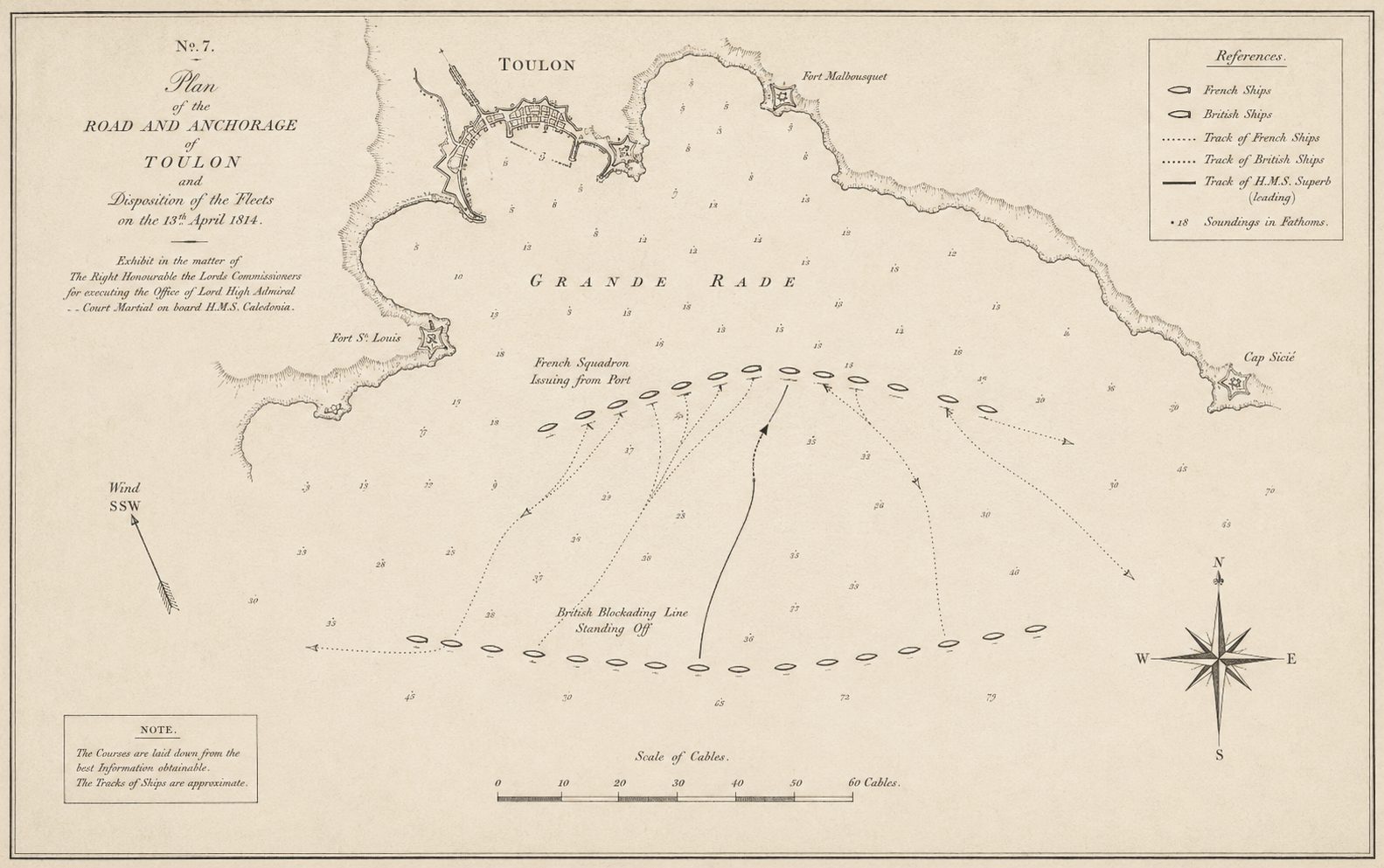
I was seventeen years old and I was her glass. I believe you all across the pond call it Timekeeping now. We didn’t have a fancy term then. I carried the half-hour glass, and I turned it, and I told her what was left of her Magazine. She had taken me out of the ship’s boys herself, for my steadiness, and I have thought about that word for sixty years. I was small, and I was quiet, and there was a good deal of room left over in me for listening.
It was the kind of listening that didn’t require ears, of course. She had my ears stopped with wax and flannel before every action, because a boy who cannot hear the guns keeps a truer count. That is true. I used to shout at her all day like a deaf man at a dog.
My hands were bad, chilblains out of the workhouse, scarred at the knuckles. I kept them half up my cuffs even in April. She never told me to take them out.
She was standing at the weather rail — the side the wind comes from — and was counting them down the Grande Rade as the land breeze brought them out: nine of the line, three frigates, and the great Wagram in the centre with her hundred and thirty guns and an admiral’s flag at the main.
Eleven years that fleet had waited for the sortie. Napoleon was losing on every road in Europe then, and his last ships had come out to die at sea instead of in harbour. I felt Jane approve of it. He had earned her respect.
“Signal from Flag, ma’am. Prepare for battle.” Mr. Hale was sixteen then, and the boy went pink at the ears whenever he spoke to her. But who could blame him? A boy just discovering his manhood around a woman like her? The poor sod just didn’t have the ability to hide it like the rest of us.
“Thank you, Mr. Hale.” She shut the glass. “Mr. Pryce.”
I came up at a run with the glass in both arms, as I had been taught, and took my station at her left elbow, aft of the mizzen where the fragments went least.
“Full, ma’am,” I said, too loud, because of the wax. “Turned at seven exactly.”
That meant three hours and thirty minutes in her Magazine. If you know anything about people like her, you’ll know that’s a good-sized, if not large, one. And that wasn’t for lack of anything.
The Royal Navy had taken everything she had. It had been three hours and thirty minutes for nine years by that point and she was five-and-thirty at the time. Not old, by any means, but you need to understand how these things work.
The Weight is what you are born with. How powerful you are at the thing you’d been gifted with by God. The Magazine is what you build, and you build it young or it takes a lot of work to do so later. Gunnery is the only part that goes on improving as long as you live. So, Gunnery is what she had put her time and effort into perfecting.
So mark the figure, lad, and keep it by you. Three hours and thirty minutes. That was the purse she carried into the victory of the age. England knows what she said the day cost her. I am the last man alive who knows what it truly cost. You shall have it before the end, and you will be the first. Keep the count as we go.
Then the drums beat to quarters — that is every man to his station and the ship taken to pieces round you while you stand in it, bulkheads down, hammocks up, decks wetted and sanded — and she laid the net.
[ The witness was asked to describe the timekeeping link, and to state how much of what follows he had from it ]
When she laid her net, she held everyone in her hand. But with me, it was different. I held her time and that meant the line from her to me was from her chest to mine. What came back up mine was her. Not her words only. The shape of her. What she was pricing, what she had settled, what a thing had cost her.
Jane read down the enemy line and I got it as she got it. Candle, candle, candle. The third and fourth rates, bright enough, raw with their harbour years.
And then the Wagram.
She stopped and read it twice, and the second reading came up my thread like cold water down a shirt.
A Weight like an explosion held politely in a man’s chest. She had read the reports out of the Adriatic and docked them thirty percent for French arithmetic. Problem was that the reports hadn’t exaggerated him. They had undersold him.
The man’s name was Lazare Brun. He was known as the Emperor’s Thunderbolt. Napoleon’s great champion.
Her mouth went dry. Mine had that too. She put her hand on the hilt of her sword, which she did when she was thinking. She had never gone up against anything like this in all those years. She, of course, had no idea what awaited her in New Orleans. But I’m getting ahead of myself.
The lines closed through the first hour the way fleets do, with immense slowness and no mercy in it. Our Superb, leading the van, opened the affair at half a cable — a hundred yards, near enough to see faces — with a full double-shotted broadside into the Wagram’s bow. Two balls to a gun instead of one. Better than seventy round shot. Close on a ton of metal in the air at once.
And the bloody iron bent.
It swept wide in one motion, like a hand brushing crumbs off a table, and stood up a white fence of sea a hundred yards to leeward.
Then the Wagram answered. And not with her guns.
The Superb’s foretopmast left her. It didn’t break, mind you. It just left. Plucked up and thrown down across her forecastle guns with its yards and its men in it. Ten thousand of the King’s sailors understood in the same moment and it sent terror down our spines.
There was a ship in that line which could not be hit. And it could destroy without powder.
“Ma’am,” I said, feeling cold sweep through every inch of me.
“Weight,” she said. “It is only Weight, Mr. Pryce. It might win moments. Gunnery wins wars.” She turned and smiled at me, and I knew, in that moment, I would go through fire for her.
SECOND SITTING — 6TH MARCH
The Wagram’s side lit down her whole length, and the world went to iron.
Jane had perhaps two seconds and she spent the first of them reading the flight. I had the count off her as she took it. Sixty balls and more in that broadside, and she sold the most of them short before they cleared the smoke — wide, high over the tops, into the sea. What could touch us: eighteen or nineteen, most of it high, into the rigging on the roll. Two low. And of the two only one mattered, an eighteen-pounder coming for the wheel, and the four men on it.
Now here is the rule. If you take nothing else out of this, take this one, because it is the doctrine she lived by.
Never buy what you can rent.
Stopping an eighteen-pound ball at speed is buying. And she didn’t have as much as Brun. It would have cost her half an hour out of three and a half, in the first quarter of a day-long action.
Turning it. That’s cheap. That’s renting.
She reached out what felt like a finger and touched the ball’s nose two degrees to larboard in the last fathom of its flight.
It took six feet of hammock netting, the rail behind it, and went over the side trailing rope-ends. The four men at the wheel never knew what had come for them.
“Wide, you buggers!” Harding, the quartermaster, spat over his shoulder at the splash.
The second ball she left entirely alone, because her eye had already sold it short. It struck the sea at thirty yards and skipped over the waist doing nothing.
“It seems it is now my turn,” she said. And then, down the thread: Marsh, if you please.
Been waiting all morning, ma’am, came Marsh’s reply, dry as sand, the way he was.
And across the smoke she watched Brun’s great light flare to meet the first ball — flare, and swat it away, contemptuous. Then flare again for the second. And again. And the fourth time the flare came a half-instant late, and the ball he had priced as another nuisance took the Wagram’s fore shrouds fair and parted them.
A shilling a swat, monsieur, her voice came up the thread to me, dry as you please.
She had four hundred more shillings’ worth of afternoon to sell him, and she stood at her rail with her hands clasped behind her back. However large his Magazine, he would come to the bottom of it.
At three bells the iron stopped between one ripple and the next.
Across the water his light had gone quiet. For an hour it had been all answer. Flare and swat, flare and swat, a man conducting an argument with four hundred interruptions. Now it drew inward and sat still.
He had stopped caring about her guns.
“Marsh,” she said. “Stand by—”
And Harding left the wheel. He was picked up by something like invisible hands and went up and outward. Over the netting, out past the mizzen chains, down.
Jane’s reach was in the battery, twelve threads and a working half laid. She tore it loose and flung it aft.
He did not come up. The sea folded him under the ship’s own wash between one heave and the next. The wheel spun its spokes over, leisurely.
And I felt her hands close on nothing at all.
She stood that way for a moment and then let it go.
“Taylor!” Loudon, the post-captain, had the roar of a man twice his size. “Taylor, the wheel, God’s sake—”
Taylor came up the ladder at a run with a boatswain’s mate shoving him from behind, and for the length of that run the Caledonia belonged to nobody.
A ship’s guns are bolted to her sides. They point where she points. Take the hand off her wheel and the wind and the sea have her, and she swings. Slow and enormous, a thousand tons going where nothing tells it not to, and every gun on the larboard side goes round with her, off the enemy and out onto empty water. Do you understand?
Up through the gratings from the gun deck, I could hear the cursing of crews watching the Wagram slide out of their ports with nothing they could do about it.
Taylor got the spokes and hauled her back. The bow came dragging round, the first gun bore again.
You see, thirty seconds of our guns had cost him almost nothing. Brun was intent on showing us that he could rent as well as he could buy.
Then, overhead, with a crack like a nine-pounder, the mizzen topmast parted. No shot had come near it. Forty feet of pine, the top platform, two furled sails and a quarter of a mile of rigging tipped off the broken stub and came down at the quarterdeck.
At the wheel. At me.
I did not move. I stood, like a fool, with my arms round the glass and watched it come.
I could see her price it. And I knew what the right choice was. The right choice was to let it go. Let me die.
You see, he had been looking for her all battle and couldn’t find her. She was spending so little he had nowhere to look. The hunt for her would have stayed blind, and staying blind was the only means of any of us living through the afternoon.
She should have let me die. But she was Jane Strachan and arithmetic be damned. She would save whoever she could.
She got under it with everything, her whole Weight in one brute shove that emptied fifteen minutes of her between heartbeats. The mass slewed sideways. It cleared me by the width of a coffin, cleared the wheel, and came down on the boats amidships. Blocks rained after it, ringing off the gun barrels. Somewhere forward a marine sergeant whispered Christ Jesus. Not as a curse. The way men say it in church.
She wiped the blood off her nose with the back of her hand and did not look at it. I nearly cried.
All she said was, How much have I left, Mr. Pryce?
Fifty-two minutes, ma’am, I said. You have fifty-two minutes left of your Magazine.
And across the water, Brun’s light flared. He had found her.
THIRD SITTING — 11TH MARCH
The Emperor’s Thunderbolt had found Jane.
A boom came thirty seconds after. A studdingsail boom — a spare spar, twenty feet of it — snatched spinning out of the wreckage and whipped flat across the quarterdeck at the height of her collar.
A small nudge at the last fathom, and it passed her on a breath of wind, blew six feet of rail into the sea a yard to her right, and went end over end into the swell.
Then silence, out in the smoke. Brun went very still—
—only for the top of our mizzen to come off the boat tier entire and fly straight at the quarterdeck. At her. Forty feet of pine and iron, his weight behind it every inch of the way.
Aimed things can be touched aside. Driven things are a different matter. Her nudge would do nothing to a mass that was being pushed like that.
So Jane broke it. Met it eight feet out and burst it into a cloud of spars and blocks that went over and past and round her, drumming the deck, and one piece laid the marine sergeant’s cheek open. For a moment there was nothing but the screaming, as if the ship itself had found voice.
And she stood in the middle of the raining pieces having spent like a drunk sailor, chest heaving from the strain.
Thirty-six, ma’am. I found that my legs had gone soft.
Jane turned and looked at me. The feeling that came from her into my chest was terrifying. It was a woman entirely certain that the leviathan across the water could crush her like a fly, and deciding she was going to kill it anyway.
He drew his flame home from its edges. All of it, every ragged flame pulled inward to the hard centre, the way a sea stands up over shoal ground. And it kept gathering, past anything I had felt off him all day and past anything I have felt since.
And then it aimed at the mainmast. At the heart of the Caledonia — everything the Thunderbolt had, in one stroke.
There was no counter, and she knew it in the first moment.
She priced the barrier — everything she had left, thrown up whole. The wall would lose. His gathered sum would go through thirty-one minutes of her like a round through a hammock.
She priced running the ship off. Too slow by half a glass.
She priced the wall again.
And she built it. Slow. Showing.
Jane made an opera of it. Light standing up off the quarterdeck in a shape ten thousand men would swear to differently by evening. The smoke of the whole action bending flat round its edges. The sea before the larboard side pressed smooth in a long white lane.
Jane called out, and what rose from her was not mere voice: the light bent and coiled round her shoulders like rope-smoke, and every sound on that deck stopped. “You will see the Emperor’s Thunderbolt struck down this day, gentlemen. And by a woman.”
Down the net her twelve guns fell silent one at a time. The captains could feel her through the threads, feel the tank behind their whole battle pouring out into the sky, and man after man stopped laying his gun and turned aft to look at what the goddess was doing.
And Brun saw it. The English light, out of hiding at last, rising to meet him exactly as mass demands to be met, exactly as his whole doctrine said an honourable thing must do at the end.
“Twenty, ma’am,” I said. “Fourteen—”
He leaned his everything onto the barrier. He knew it would not hold. He would have bet his life on it.
And he bloody did.
Through the bottom of that one second — while the whole of him was extended across a quarter-mile of smoke, pressing on a wall she had never meant to hold — she went low.
Under her own opera. Out across the water. A working no thicker than a thread, skimming the swell at the height of a gunport.
Through the Wagram’s open midships port.
And inside, the gun deck she could not see and did not need to, because every gun deck in every navy in the world is furnished the same. Beside each gun a bucket of powder charges in flannel bags, ready to load. And beside the bucket, kept burning through every action, a slow match, a length of smouldering cord on a stick. The fire they touch to the gun to make it speak.
She had priced that match at the start of the opera, and priced it true. Four blind seconds inside his hull, feeling for a stick of fire while his weight sat home and watchful. Suicide, at any moment of that day but the one she had just made.
She found the match and tipped it out of its rack.
Eighteen inches. A farthing’s weight of force.
It fell where everything on that deck stood waiting for fire.
The wall broke, exactly as he had wagered. She let go of it whole and his flood came on through the wreck of it with our mainmast one heartbeat from ruin.
And the Wagram’s side lit from within. Light standing out through every port and hatch at once as the fire found the bags, and the bags found the hoist, and the hoist ran down to the rooms below the waterline where a hundred tons of powder slept.
The Emperor’s flagship opened like a struck bell becoming light.
The flood died in the air, mid-stroke. Gone wherever workings go when the man beneath them ends.
Behind it the column stood up off the water, gold and black, tall as a cathedral. They saw it from the hills above Toulon. They saw it from Corsica.
She closed the threads gently, one at a time.
She let go of me last. I felt the warm line unhook out of my chest, and I have had nothing like it since and do not expect to.
The deck was utterly silent.
And down the last thread before she let it go, Marsh, hoarse: What did it cost you, ma’am?
“A farthing, Marsh,” Jane said. And she smiled.
Eleven minutes.
She had cut it to eleven minutes.
FOURTH SITTING — 14TH MARCH
The sea burned until the middle watch.
Not the French flagship. She was gone by sunset, and gone entire.
The sea burned where she had been. Patches of oil and shattered spar flaming low on the swell, a mile of people dying slowly in the dark, and our boats going among them with lanterns at their bows, pulling Frenchmen out of the water.
Jane had the deck. She stood at the weather rail with hands clasped behind her back and watched the boats do the other half of the Service’s work, the half the broadsides never mention. Hooks and blankets and the bowman leaning out — doucement, doucement — a burned man screaming when the gunwale touched him.
They brought a lieutenant up the side. Hands wrapped to the elbows, face scorched eyebrowless, a boy of nineteen under all of it. He stood swaying on our deck between two marines and looked round himself at what was left of the enemy’s flagship. Then up, at the quarterdeck. At her.
Somebody in the boats must have told him. Or he looked at the only woman standing on a post-captain’s walk and knew. His eyes went down the whole length of her and came back up to her face.
“La Sorcière d’Angleterre,” were the only words out of his mouth. The Witch of England. It’s a name you Americans were fond of calling our Jane, is it not? The lieutenant would not say anything else. They took him below to the surgeon.
I have thought about him more than I have thought about Brun. I’m not sure why, to be quite frank with you.
Under our feet, through the skylight of the great cabin, the victory was being drunk.
The captains of the inshore squadron had come across at sunset, boat after boat, and the toasts came up all watch long like bubbles through a pond.
To the King.
To the immortal memory.
To the victory of the age.
Each one followed by the rumble of a dozen chairs and the ring of struck crystal.
She stood her watch above them on the planking and heard the whole of it without a word.
Then a new voice. Young, half drunk, a frigate captain by the carry of it.
“Gentlemen! I give you Farthing Jane!”
The cabin roared. The glasses rang like rigging in a gale.
The name had gone through the fleet in an afternoon, gun crew to gun crew, boat to boat. Marsh had it from her own mouth and the lower deck had it from Marsh by supper. And by the time the Sparrowhawk made Portsmouth it would belong to England.
Farthing Jane. The woman who bought the Emperor’s flagship for a quarter-penny.
[ The sittings being concluded, the witness was asked whether he would consent to be deposed further, upon the American war ]
Did I not tell you at the start? Everybody wants New Orleans.
Best send for more paper, lad.
Part II
Marsh Ross, Interviewed
Gun captain, HMS Caledonia. Taken down decades after the action.
Taken at Gosport, the 3rd of June 1849, from Marsh Ross, gun captain, His Majesty’s ship Caledonia, aged seventy-five. At that date this Section held no likeness of Strachan and no description of her in any hand but the printsellers’. Obtaining one was the object of the interview.
[ The witness was shown the print. ]
That is not her. I will tell you everything wrong with it and you may write it all down.
She never raised her arm. Not once, not in eleven hours. She stood at the weather rail with her hands folded like a woman waiting on a coach. Even when her nose bled, Jane barely lifted a hand to wipe it. She hadn’t the time. She would no more have worn a bedsheet on a quarterdeck than I would. Whoever drew that was never aboard. What, Tully says it’s a fair likeness? Tully’s half blind though, isn’t he?
[ The witness was asked to describe her. ]
Ah. Now that’s something, isn’t it? How does someone describe someone like Captain Jane Strachan? Well, for starters, she was middling height. Handsome as anything, and I will not pretend otherwise, for it is the first thing every man aboard settled in his mind and got done with. If you had never watched her work you would have said she was a lady out of somebody’s portrait, got loose from a print-shop window.
Her face was fine as a cameo, I tell you. Pale, dark-browed, the hair on her head almost curly and black, drawn back but always coming out of it in wisps. She arranged herself with care, I’ll tell you that. But the arrangement sat on her like armour more than anything. She wasn’t hiding what was under it, but she had learned to let the world see the part she chose and no more.
She was slender through the shoulders. Almost nothing to her at all, I used to think to meself. Hardly more than a boy’s width of chest and shoulders under the epaulettes. Ah, but then the long skirts of the coat would move when she came down a deck, the roll going through her as if the sea had signed articles with her personally. No, no. There is no drawing that. And a man at sea is a man at sea. I looked where I oughtn’t, I won’t deny it. And so did every man on that gun line, don’t let anyone tell you otherwise. It never once occurred to any of us to say so to her, though.
[ The witness was asked to keep to the face. ]
Right. ’Course. Her eyes were black, the fleet would tell you. The fleet never stood as close as I did. There was blue at the bottom of them, dark as the coat she stood in. Like I said, fine as a cameo.
And she was, as of that afternoon, the deadliest thing I ever stood a watch with. It did not seem to me then and does not seem to me now that those two facts had any business sitting so easy together in the one person. But there they were.
Captain Strachan, we all called her. She had no commission. Not then. Not yet. She was a warrant officer and the title was not hers until much later. She owned that deck all the same, and every man on it had watched her buy it.
[ The witness was asked what the ship had expected of her. ]
Fifteen years I served with Charisms before her. Big Weights out of the yards, nervous boys the Service had rated and ruined, one old Dane in the Téméraire who could talk anybody into anything. Every one of them you would have picked out of a crowd. Something about the walk, isn’t it? Spent. Gaunt.
Her reputation came aboard before she did, so the people looked for something out of a ballad. Boadicea in a broadside print, ten feet tall with lightning in her fists. Bloody fools. What we got was a young woman you might have passed in Portsmouth High Street and given a second look only if you were minded to court her. That woman reached a quarter of a mile through the smoke and put out the Emperor’s Thunderbolt like a candle at bedtime.
The ballad you can sing about. This one I would have followed into fire, and gladly.
[ The witness was asked whether he had spoken with her after the battle. He asked leave to tell it in his own way. The following was his account.]
The gun was named in the night.
I saw it at first light, before the calls on my own eighteen-pounder. It was the aftermost. I saw the chalk on the warm iron of the breech in a square gunner’s hand: CAPTAIN STRACHAN. And under it, smaller, another hand, one of the boys by the look of the letters: a farthing wel spent.
I did not rub it off. I stood there a while with my knuckles on the breech of the gun. That gun that killed nothing all day and we had won the battle anyway. Then I fell my crew in on it and waited with the rest of the ship to see what she would do. The whole deck was waiting. Forty men studying the horizon with enormous attention.
She came down the line with the sun barely off the water. She stopped at my gun and read the chalk, both hands of it, the square letters and the small one. Her face gave the iron nothing. Then she put her hand on my shoulder. I was the closest thing she had to a friend, wasn’t I?
“Have it wiped, won’t you, Marsh?”
“Aye, aye, Captain,” I said without thought, and I saw the annoyance go across her. Then the annoyance gave way and there was a hint of amusement under it. I knew then that she was the same woman I had known all those years, which was a comfort to me. Jane gave me one nod and she was gone.
I told Tully to sponge his gun, and to put his name under it next time, the blasted coward.
Part III
What England Printed
What survives of the printed record from the six months after Toulon, in the order England received it. One page is honest, one is invented, and the rest are refusals.
The fleet’s name went ashore as Farthing Jane and came back six months later wearing a toga. By August the print was in its fourth impression; a public house in Gosport had taken the one name and a coaching inn on the Bath road the other. Boys followed her to the baker’s. A clergyman preached on her. A manuscript of that sermon resides at Eastbourne House. She was asked to lend her name to a subscription, a soap, and a memoir, and answered all three in the same hand on the same morning; the retained copies are reproduced below.
None of it began in London. The name went along the gun decks first, then the boats, then the great cabin, and reached the printsellers last. Which is why The Light of Britannia was drawn from a description obtained at second hand and got the woman wrong. The fleet’s name she answered to. The nation’s she did not, and nobody who had served with her used it.
Admiralty-Office
Dispatches received from the Mediterranean fleet
Sir,—I have the honour to acquaint their Lordships that the enemy’s fleet came out of Toulon on the morning of the 13th instant, and that after an action of some hours the enemy was entirely broken up, with the loss to him of two ships of the line taken, one burnt, and his flag-ship destroyed.
The destruction of the Wagram was occasioned by an explosion of her magazine, the cause of which is not certainly known, and cannot now be ascertained, no officer of that ship having survived. It is proper to add that she had been closely engaged for some hours previously by His Majesty’s ship Caledonia, and had suffered considerably in her rigging.
The conduct of every officer and man in the squadron was such as I have long been accustomed to expect. I have particularly to mention Captain Loudon of the Caledonia; and Miss Strachan, warrant officer of the particular service attached to that ship, whose exertions through the whole of the action, and in the preservation of the flag-ship, I cannot too highly commend.
I have the honour to be, Sir, your most obedient humble servant,
— Vice-Admiral, commanding
Note. Sheet supplied by Eastbourne House. This is the most accurate document in the file, and the afternoon is not in it. She is commended for what ten thousand men saw — the flagship preserved — and the Wagram is an explosion of cause unknown. What she actually did appears in no dispatch, because no one who wrote dispatches knew it.
The Light
of Britannia
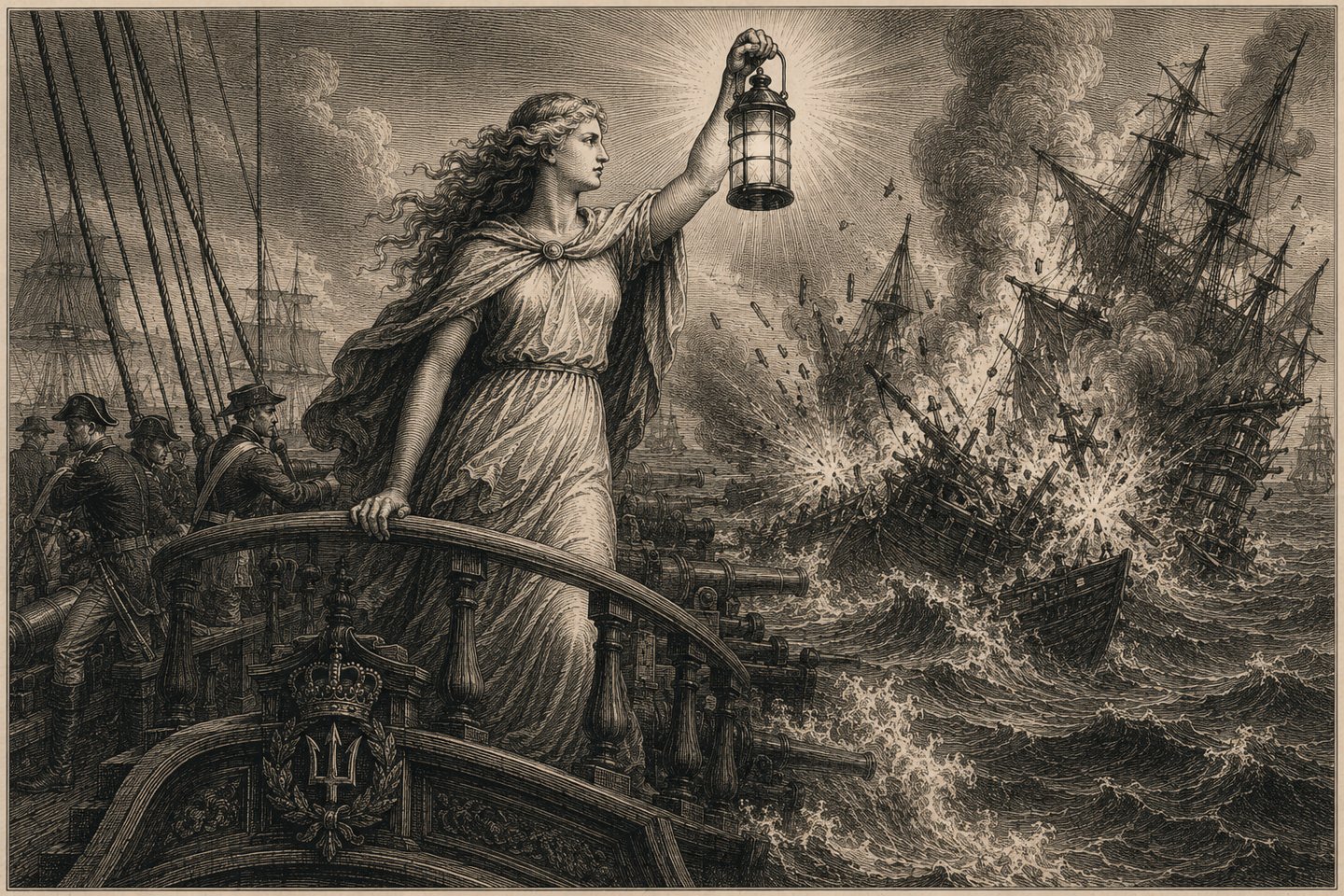
Representing the Moment in which the Light of Britannia, raising her Arm above the Quarter-Deck of the CALEDONIA, did strike down the Thunderbolt of the Corsican, and did deliver the Fleet.
Drawn from the accounts of officers present · Engraved on steel
Price two shillings plain · three shillings coloured
Proofs on india paper to subscribers only
Note. The engraver had not seen her, and worked from a description obtained at second hand in a Portsmouth coffee-house.
Three applications were answered on the same morning in August: a subscription got up in her honour, a soap, and a memoir to be written by another hand. The retained copies are identical but for the address.



Note. The memoir was published in the spring without her cooperation. It sold well.
Part IV
Portsmouth
October 1814. The letters, and the answer.
The Caledonia paid off in the summer. Letters survive between Miss Strachan and Marsh Ross, whose interview forms Part II of this file. The letters are reproduced here in transcription, with the Admiralty correspondence, in order. Once more, they are produced with the approval of the Strachan Foundation™, which owns the originals, as it has twice now been recorded.
Ross to Strachan · Gosport, September 1814
Madam,
They have paid off the old ship and I am ashore at Gosport with my daughter and her husband, who keep me better than I deserve. There is a public house here now bearing the name the fleet gave you. I have not gone in. Tully has.
If there is a ship for you again, ma’am, and they give you any say in her people, I am not so old as the Navy Board thinks.
Your obedient humble servant,
M. Ross
Strachan to Ross · Portsmouth, October 1814
Marsh,
The peace is six months old and I have learned what it smells like: paint, pitch, and idleness. Ninety-one ships gone into ordinary in this harbour by my own count, topmasts struck, guns landed, crews paid off by the thousand onto quays with no work in them. The Service is putting itself to sleep like a great animal for winter, and it does not know what to do with someone like me when the wars run out.
I have rooms near the Hard and I wake every morning with a full Magazine, and there is not a market in England that will take the coin. I begin to think the peace will kill me as surely as Brun would have done. Only slower, and at a worse rate of exchange. Am I expected to be grateful for the terms?
If a ship comes, you will hear of it before the Gazette does. And tell Tully I expect a report on the ale.
Yours &c.
J.S.
The following reached her with the October packet, sealed and particular.
The Lords Commissioners of the Admiralty to Miss Strachan
The Lords Commissioners of the Admiralty present their compliments to Miss Strachan.
Their Lordships have under consideration the war remaining to His Majesty in the Americas, and a squadron now forming under Vice-Admiral Cochrane for operations against the enemy’s Gulf coast; and the exigencies of that service being such as to require Weight of a particular kind;
Their Lordships beg leave to inquire whether Miss Strachan’s warrant might be extended to particular service in the Americas.
Strachan to Ross · the same week
Marsh,
They've asked me to extend my particular service, with words like: Beg leave. To inquire. Whether it might. The sentence reads as some clerk in London flinching three times in the writing of it. And that from a body that has moved me about the ocean for fifteen years on a signature.
The squadron is for the Gulf coast. You can read water as well as I can: every road in that ocean runs to the mouth of the Mississippi, to the city that holds the river that holds the continent.
Marsh, if you please. We’re off to the Americas.
Yours &c.
J.S.
Her answer to their Lordships went to the post the same afternoon, through the streets of a town that knew her face.

She sailed before the end of the year. They had engraved her, and they had failed to capture her image. Jane Strachan was determined that New Orleans would see her for what she truly was.
— T.F.
End of file S3/Hist-11
Farthing Jane · © Jackson Tran · orionuniverse.net